Showing posts with label communion. Show all posts

Tuesday, 23 April 2013

Restoring the New Testament Church By Looking Backwards

The term "restoring the New Testament church" is popular in our time.  Church plants often trumpet a vision around this theme, and that's not a bad thing.  It acknowledges that our present practice of church life is lacking something compared to what is described in the New Testament.  It's not difficult to get a group of Christians to agree to the question, "Should we build a New Testament church?"  However, agreeing to do this and actually creating such a church are very different things.

What is a New Testament church?

After agreeing to the first question, the next question becomes, "What exactly does a New Testament church look like?"

The fact is there is no single ideal New Testament church example that we can follow.  We see some variety, but more importantly we see failure mixed in with success.  The Jerusalem church leaders had trouble distributing the food to the widows and needed financial support from the other churches when a famine hit, the Galatian church was sidetracked by legalism, and the Corinthian church had chaotic meetings and members who sued each other.  The church at Sardis had a reputation for being alive but was dead, and the Laodician church was lukewarm.  Each one of these was a New Testament church, but when folks say, "Let's build a New Testament church," they probably aren't referring to these specific characteristics.

Some people see the New Testament church as one that emphasized evangelism, or practiced intimate community life among its members, or every member serving rather than letting a paid professional staff do all the work, or team eldership, or the full functioning of the spiritual gifts, or an emphasis on relational ministry rather than a focus on church buildings and programs.  Any of these goals are noble and would represent a step towards the original behaviour of the New Testament churches.

But getting agreement on the specific qualities of a New Testament church is still not the most difficult question.  That crown belongs to this question:

How do we actually build a New Testament church?

Answers to this question are harder to come by, at least by successful practitioners.  Critics are a dime a dozen, but leaders who have actually accomplished what they set out to do are fewer.  Setting out a vision and achieving that vision are very different things.

Many church planting methods are out there, and some of them actually work.  I have no desire to repeat or debate those -- others are better qualified at that than I am.

However, as we are busy restoring an aspect or two of the New Testament church, how do we keep from losing some of our existing church traits that are good?  How can we ensure we move forward in one area without taking a step backward in another?

I propose to tackle this question of restoring the New Testament church from a completely different perspective.

Learn By Looking Backwards

If we are lacking characteristics from the original New Testament churches, that means at some point along the journey the church lost those characteristics.  It seems therefore that if we understand why and how the church lost those traits in the first place, it may help us both to restore them and how to avoid losing them again in our generation.

So in coming blog posts, I want to try to answer questions such as, "How did the church ...

  • ... lose baptism by faith and adopt infant baptism?"
  • ... lose team eldership and vest church authority in a lone bishop?"
  • ... lose symbolic communion and believe the bread and wine literally become the flesh and blood of Christ?"
  • ... lose the priesthood of all believers and adopt a distinction between clergy and laity?"
  • ... lose the independence of each local congregation and adopt a central hierarchy that imposed decisions on other churches?"

... and numerous other similar questions.

It's not always possible to answer these questions with absolute authority because historical church records were not written for the purpose of answering these questions.  Therefore, most of the time the answers will have to be inferred.  However, I believe we can glean enough information to understand what caused the church to lose these traits in generations past, and therefore understand what errors we need to avoid in our time.

Saturday, 9 April 2011

Ignatius

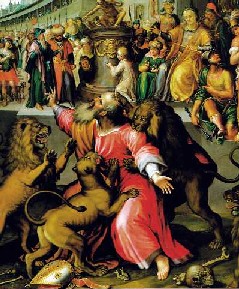
Ignatius (~35 AD - 107 AD) was Bishop of Antioch in Syria.  He was likely a student of the Apostle John, along with his friend Polycarp who was Bishop of Smyrna.  Ignatius was arrested and escorted by soldiers to Rome to be executed by wild beasts in the arena.  Along the way, he wrote 6 letters to churches and one letter to Polycarp.
Martyrdom of St. Ignatius of Antioch

While writing only about a decade after Clement, Ignatius' views on a number of issues are clearly diverging from what is found in the New Testament.

One area of difference is communion, or the eucharist.  Ignatius considers the bread to be the flesh of Jesus Christ, rather than just a symbol of Jesus' body.  It seems this position came out of his desire to correct a growing heresy that Jesus had not really risen from the dead with a physical body.  Regarding heretics, he says:
"They abstain from the Eucharist and from prayer, because they confess not the Eucharist to be the flesh of our Saviour Jesus Christ."  Letter to the Smyrnaeans ch. 7

Another first we see in Ignatius' writings is the term "Catholic Church."  Catholic in Greek simply means whole, complete, or universal.  It was a generic term at the time and it seems that Ignatius intended to distinguish the majority of the churches (catholic) from the few that were following clearly heretical teaching.

The most significant change from the New Testament model is found in Ignatius' description of church leadership.  Unlike Clement, Ignatius treats bishops (i.e. overseers) and elders as separate roles in the church, with a lone bishop being in authority over the elders.  He equates the bishop with God the Father, and the elders with the Apostles, and teaches absolute obedience to the bishop as one would give to God.  In terms of church life, the bishop was the only one permitted to authorize baptisms and perform the Eucharist.  In his letter to Polycarp, he even says that people who marry should do so with the approval of the bishop.  Note that in the quotes below that "presbytery" is synonymous with "elders."
"I salute your most worthy bishop, and your very venerable presbytery, and your deacons, my fellow-servants, and all of you individually."  Letter to the Smyrnaeans, ch. 12.
"See that ye all follow the bishop, even as Jesus Christ does the Father, and the presbytery as ye would the apostles; and reverence the deacons, as being the institution of God.  Let no man do anything connected with the Church without the Bishop.  Let that be deemed a proper Eucharist, which is [administered] either by the bishop, or by one to whom he has entrusted it.  Wherever the bishop shall appear, there let the multitude [of the people] also be; even as, wherever Jesus Christ is, there is the Catholic Church.  It is not lawful without the bishop either to baptize or to celebrate a love-feast; but whatsoever he shall approve of, that is also pleasing to God, so that everything that is done may be secure and valid."  Letter to the Smyrnaeans, ch. 8.
"... your bishop presides in the place of God, and your presbyters in the place of the assembly of the apostles, along with your deacons."  Letter to the Magnesians, ch. 6.
"It is well to reverence both God and the bishop.  He who honours the bishop has been honoured by God; he who does anything without the knowledge of the bishop, does serve the devil."  Letter to the Smyrnaeans, ch. 9.

It is not entirely clear how this new office of bishop was instituted, but it clearly was not just an anomaly in Antioch.   In his letter to the Ephesians, he states that bishops "settled everywhere to the utmost bounds" of the earth.  He also specifically mentions the bishop of Smyrna (Polycarp) and the bishop of Ephesus (Onesimus).  Clearly this practice of having a single bishop over the elders of a church had become widespread in a very short period of time after Clement.

Despite his pleas to the churches to obey their bishop, Ignatius is not simply power hungry.  He comes across as a gracious, Godly man in his tone and words.
"I do not issue orders to you, as if I were some great person.  For though I am bound for the name [of Christ], I am not yet perfect in Jesus Christ."  Letter to the Ephesians, ch. 3.

Ignatius' writings show how the early church was quickly adopting a new organizational structure to deal with the heresies that were creeping into the churches.  It seems to have been an intentional change, borne out of good motives to solve a very real and serious problem. However, the consequences would turn out to be severely detrimental in the years that followed.

Error in The Pilgrim Church Book

Broadbent attributes a misuse of Acts 20:17 to Ignatius.
"Commenting on Acts 20, he says that Paul sent from Miletus to Ephesus and called the bishops and presbyters, thus making two titles out of one description, and says that they were from Ephesus and neighboring cities, thus obscuring the fact that one church, Ephesus, had several overseers or bishops." p. 32

After reviewing all of Ignatius' writings, I could find no such reference to Acts 20.  I tracked down Broadbent's source, a book by Henry Alford entitled The Greek Testament Critical Exegetical Commentary.  In Vol. 2, p. 227, Alford does describe this exact misuse of Acts 20, but attributes it to Irenaeus rather than Ignatius.  Problem solved!