Showing posts with label baptism. Show all posts

Tuesday, 23 April 2013

Restoring the New Testament Church By Looking Backwards

The term "restoring the New Testament church" is popular in our time.  Church plants often trumpet a vision around this theme, and that's not a bad thing.  It acknowledges that our present practice of church life is lacking something compared to what is described in the New Testament.  It's not difficult to get a group of Christians to agree to the question, "Should we build a New Testament church?"  However, agreeing to do this and actually creating such a church are very different things.

What is a New Testament church?

After agreeing to the first question, the next question becomes, "What exactly does a New Testament church look like?"

The fact is there is no single ideal New Testament church example that we can follow.  We see some variety, but more importantly we see failure mixed in with success.  The Jerusalem church leaders had trouble distributing the food to the widows and needed financial support from the other churches when a famine hit, the Galatian church was sidetracked by legalism, and the Corinthian church had chaotic meetings and members who sued each other.  The church at Sardis had a reputation for being alive but was dead, and the Laodician church was lukewarm.  Each one of these was a New Testament church, but when folks say, "Let's build a New Testament church," they probably aren't referring to these specific characteristics.

Some people see the New Testament church as one that emphasized evangelism, or practiced intimate community life among its members, or every member serving rather than letting a paid professional staff do all the work, or team eldership, or the full functioning of the spiritual gifts, or an emphasis on relational ministry rather than a focus on church buildings and programs.  Any of these goals are noble and would represent a step towards the original behaviour of the New Testament churches.

But getting agreement on the specific qualities of a New Testament church is still not the most difficult question.  That crown belongs to this question:

How do we actually build a New Testament church?

Answers to this question are harder to come by, at least by successful practitioners.  Critics are a dime a dozen, but leaders who have actually accomplished what they set out to do are fewer.  Setting out a vision and achieving that vision are very different things.

Many church planting methods are out there, and some of them actually work.  I have no desire to repeat or debate those -- others are better qualified at that than I am.

However, as we are busy restoring an aspect or two of the New Testament church, how do we keep from losing some of our existing church traits that are good?  How can we ensure we move forward in one area without taking a step backward in another?

I propose to tackle this question of restoring the New Testament church from a completely different perspective.

Learn By Looking Backwards

If we are lacking characteristics from the original New Testament churches, that means at some point along the journey the church lost those characteristics.  It seems therefore that if we understand why and how the church lost those traits in the first place, it may help us both to restore them and how to avoid losing them again in our generation.

So in coming blog posts, I want to try to answer questions such as, "How did the church ...

  • ... lose baptism by faith and adopt infant baptism?"
  • ... lose team eldership and vest church authority in a lone bishop?"
  • ... lose symbolic communion and believe the bread and wine literally become the flesh and blood of Christ?"
  • ... lose the priesthood of all believers and adopt a distinction between clergy and laity?"
  • ... lose the independence of each local congregation and adopt a central hierarchy that imposed decisions on other churches?"

... and numerous other similar questions.

It's not always possible to answer these questions with absolute authority because historical church records were not written for the purpose of answering these questions.  Therefore, most of the time the answers will have to be inferred.  However, I believe we can glean enough information to understand what caused the church to lose these traits in generations past, and therefore understand what errors we need to avoid in our time.

Friday, 8 March 2013

Novatian and the First Church Split

The first significant church split occurred with the Novatians in Rome in 251 A.D. and quickly spread throughout the empire. Splits had occurred in the church before this, but it had always involved heresy such as with the Marcionites.  The Montanists tried to stay within the Catholic Church but were forced out, and while they were not exactly heretical, they had error mixed in with their desire for renewal and it muddied their situation.  Not so with the Novatians.  There was no heresy involved, just a disagreement over a theological issue.  They intentionally elected a separate bishop and created separate churches and they continued to be orthodox in all their doctrines.  That's what makes this situation such an interesting precedent in the history of the church.  It allows us to see the original response of the Catholic Church to a disagreement over theology and how that response changed over the centuries.

Novatian (~200-258 A.D.) was baptized on his death bed and then unexpectedly recovered.  He was a priest in Rome when Fabian, the Bishop of Rome, was martyred in 250 A.D.  Because of the intense persecution, the role of bishop was left vacant for a year.

When the persecution subsided with the death of Emperor Decius (his coin pictured) in June 251 A.D., a question arose among the churches all over the empire about those believers who had "lapsed" and sacrificed to idols in order to escape death.  Should they be admitted back into the church or not?  If yes, what should the process be for readmitting them?  Should all be readmitted or just those who relapsed under extreme torture?  Should the church practice forgiveness or should the church treat them as unbelievers?

During this same time, the churches were also dealing with the grief for those believers who had remained faithful in the face of persecution and lost their lives.  Believers honoured the memory of the martyrs by celebrating their "birthdays" into eternal life.  In Carthage, some believers felt the martyrs had access to incredible supernatural power when they faced death and that their excess merit was sufficient to cover the failures of others.  They even urged their bishop, Cyprian, to issue a blanket pardon for all those who had lapsed and sacrificed to idols based on this alleged power of the martyrs.  It was the earliest seeds of the modern Catholic practice of venerating saints.

Cyprian rightly declined this request on the basis that martyrs do not have the power to forgive sins.  However, the question of readmission of lapsed believers was a sticky one.  The traditional approach was that any serious sins such as apostasy resulted in believers being permanently excommunicated from the church.  Cyprian proposed a new and more moderate approach that they be readmitted based on the seriousness of the sin.  Leniency should be shown for those who failed during the worst kinds of physical torture, while those who willingly went to sacrifice to idols should be punished severely.  Additionally, sufficient remorse should be evident on the part of the lapsed.

This approach led the church leaders to establish a graded system of "penance," or actions that demonstrated repentance based on the seriousness of the sin.  After the required acts of humility and the required time had elapsed, the person was declared absolved of their sins by the bishop, readmitted to the church and could participate once again in the sacraments.

While there was agreement with Cyprian's solution among some churches and leaders, support was not unanimous.  Novatian in Rome led the opposition on the basis that only God can forgive men from their sins, especially serious sins like apostasy or murder.  Cyprian had simply moved that supposed power of forgiveness away from martyrs and gave it to the bishops instead, and Novatian argued it belonged to neither.  Further, the church had taught clearly against sacrificing to idols before and during the persecution.  They encouraged believers to face death with courage.  Now those same leaders were welcoming back those who had failed that test.  Wasn't this dishonouring the sacrifice of those martyrs who had proven faithful to Christ?  How would you feel if those martyrs included your family members?  Why hadn't those same church leaders taught this during the persecution?  Wouldn't that have avoided a lot of unnecessary deaths?  Did this mean the church leaders were admitting their previous teachings were wrong?  One can imagine the strong emotions that must have been present on both sides of the debate.  It was not a theoretical exercise -- it had intensely practical implications for each congregation.

Another priest in Rome named Cornelius took Cyprian's position and argued that bishops did in fact possess the power to forgive sins.  This set the stage for a showdown when the election for Bishop of Rome took place.

The majority of bishops sided with Cornelius and he was elected Bishop of Rome in 251 A.D.  However, Novatian and those who agreed with his position on the lapsed were not content to accept this change in church practice.  Just because a new bishop decrees a new practice in the church, did that mean the believers who disagreed with him had to adopt that practice even if it was contrary to the Scriptures?  What options did they have?

As a result, some priests in the Catholic Church elected Novatian bishop in open defiance of Cornelius.  We don't have any versions of this process from Novatian, only from his enemies, so it's unclear how much of their version of events is embellished, but Novatian may have engineered his election using some priests who were not entirely aware of what they were doing.  However, Novatian had a significant following and they immediately began establishing new churches under his leadership and appointed new bishops in other cities.  Suddenly there was a parallel network of churches and church leaders all over the Roman Empire.

While it is possible the Novatian schism was caused in part by a personality clash between Cornelius and Novatian, it could not be the main cause.  Cornelius was martyred just two years after becoming bishop, Novatian was martyred 5 years after that, and Cyprian was martyred the same year as Novatian.  By 258 A.D. all of the original players in the schism were gone from the scene, but Novatian churches continued to exist for centuries.  It is much more likely that the schism was primarily caused by differences of theology rather than of personality.

Initially the Catholic leaders called the Novatians a schism (meaning division) which is what they were, but over time leaders such as Cyprian changed their tone and declared them heretics.  Their only heresy was that they refused to acknowledge the power of the church to absolve sins.  This is strange, because that was a new teaching in Novatian's lifetime that was adopted by the Catholic Church leadership even though it had no Scriptural basis.  (Tertullian had opposed a similar issue decades earlier when a Bishop of Rome declared an adulterer forgiven.)  Novatian was declared a heretic because he did not accept a newly-invented doctrine that had been voted for by a majority of Catholic bishops and priests.  The definition of heresy now became anything contrary to what the Catholic Church taught.  Spiritual truth was determined by democratic vote.  Those in the majority were orthodox, while those in the minority were heretics.  It had nothing to do with what the Bible taught.  There was no room for multiple opinions on any matter of church life.  This definition of heresy has been used by the Catholic Church down to the present day.

In this short period of church history, the Catholic Church invented a brand new sacrament.  Instead of just baptism and communion, there was now penance and absolution of sins.  The church had gotten into the business of setting the price for and dispensing forgiveness of sins.  It began with trivial punishments and outward signs of humility, but it would be a small step in later centuries to make that price for forgiveness purely monetary -- indulgences would be the logical conclusion of this doctrine, and it would be one of the driving causes for the Protestant Reformation.

The Novatians called themselves "Cathars" from the Greek word for "pure," so in a sense they were the first Puritans.  Some of their churches also re-baptized converts from the Catholic Church, so in a sense they were the first Anabaptists.  They strongly opposed the teaching that the Catholic Church could absolve sins and they expected that Christians' lives should show evidence of their faith in how they behave.  Their bishops were admired for their Godly behaviour and Constantine invited the Novatian bishop from Constantinople to the Council of Nicea in 325 A.D.  The bishop approved all the decrees that the council put forward but refused union with the Catholic Church.

Since the Catholic Church declared them to be heretics, Novatians were persecuted on and off for centuries, sometimes having their church buildings closed or confiscated and at other times being reluctantly tolerated.  The last reference to them is in Alexandria, Egypt around 600 A.D.

The Novatians were essentially orthodox in all the foundational doctrines of Christianity, but they rejected the un-Biblical ordinances that the Catholic Church had begun to adopt.  Their punishment was excommunication from the Catholic Church, but they didn't seem to care.


Wednesday, 24 October 2012

Cyprian

Like Tertullian, Cyprian (~200 - 258 AD) lived in Carthage (modern Tunis) in North Africa.  He was not baptized as a Christian until the mid-240's AD, but was rapidly put into church leadership roles including bishop in 249 AD.  He was fairly wealthy from a career in the legal profession, and gave some of his wealth to the poor after his baptism.  He was martyred in 258 AD.

His writings deal with controversies in the church during his time in leadership.  He also wrote about the plague that ravaged Carthage during Emperor Valerian's reign, encouraging the Christian's to stay strong in their faith and to help the sick.

One controversy he was involved in was how to deal with believers who had renounced their faith and worshiped the emperor during times of persecution and then desired to return to the church later.  One camp refused to allow them back in the church, while the opposite camp accepted all of them without question.  Cyprian took a middle ground, one that the bishop of Rome agreed with.

Cyprian was also the first early church father who championed infant baptism.  He felt they should be baptized as early as possible. Under his influence, 66 bishops declared themselves in favour of infant baptism in 253 A.D. and within a generation it had become standard practice in the North African churches.

Cyprian based many of his arguments around the term "Catholic Church" meaning the central, authoritative, and traditional church organization that claimed descent from the Apostle Peter.  In his Treatise "On the Unity of the Church" Cyprian refers to Matthew 16:18 where Jesus tells Peter that "on this rock I will build my church" and concludes that the authority given to Peter rests only with the Catholic Church.  Anyone who disagrees with the church leaders is causing disunity and is not part of the true church.  As Broadbent states in The Pilgrim Church (p.34), Cyprian went as far as claiming, "He who is not in the Church of Christ is not a Christian."

The church had now begun to exclude any and all Christians who disagreed with the most powerful bishops on non-core doctrines.  (By "non-core" I mean any doctrines of faith not expressly addressed in the New Testament.)

This large-scale excommunication of Christian believers created new practical problems in the church that had never existed before.  If an excommunicated group baptized people in the name of Christ, are those converts really Christians?  If those converts later come to the Catholic Church and renounce whatever "heresies" that existed in that group, do they need to be baptized again?  Cyprian argued yes; other bishops argued no, but it was an issue that was not resolved in his lifetime.

For the first time in history, it was no longer enough to be baptized in the name of Christ;  Cyprian now taught that one needed to be baptized in the Catholic Church to be a true Christian.

Tuesday, 23 October 2012

Origen

Origen (c 185 - c 254 AD) was born in Alexandria to Christian parents, who named him Origenes Adamantius.  His father Leonides was martyred in 202 AD, and Eusebius relates a story that young Origen wanted to be martyred with his father but was thwarted by his mother who hid his clothes.
Origen was a gifted teacher of the Scriptures and discovered this gift and passion at a young age.  At age 18 (203 AD), the bishop of Alexandria, Demetrius, appointed him to succeed Clement as the leader of the theological school there.  He performed this role for a dozen years until persecution in 215 AD forced him to flee.
Origen traveled through a number of places in his lifetime, including Rome, but he stayed the longest at Caesarea in Palestine.  There he was invited by the bishops to preach in their churches.
Despite his teaching experience and ability, Origen was still a layman and Demetrius was not happy that a layman from his city was preaching in churches in other cities, despite the approval of the local bishops.  He ordered him back to Alexandria, so Origen obeyed and he took up his position at the school.  However, in 230 AD Origen was on his way to Greece when he visited Caesarea again.  The bishops there ordained him, and this really got Demetrius upset.  When Origen returned, he was removed from his teaching position in the school and excommunicated from the church.
Origen returned to Caesarea and opened a new theological school, continued his writings and teaching, and spent the remainder of his life in Palestine.  During another persecution in 250 AD, he was arrested and tortured and died a few years later as a result.

From Origen's teachings and life events, we see the early church changing in the following ways.

  1. Infant baptism is now commonly practiced.  Origen states in his commentary on Romans that infants were baptized in keeping with apostolic tradition, and his writings do not appear to show he disagreed with that tradition.
  2. Church leadership was becoming formalized and separated from the rest of the people in the church.  The idea of clergy and laity had already become entrenched.  The fact that Origen was a more gifted teacher than many bishops did not matter to Demetrius, who excommunicated him for preaching in other churches and being ordained without his approval.  Laymen could teach in a school of theology, but not in a church!
  3. Bishops had absolute authority over church affairs in their own city.  Demetrius excommunicated Origen not because the Christians in Alexandria found him behaving sinfully or because his theology was heretical, but simply because Demetrius was jealous of his abilities and his influence with other bishops.  
  4. Bishops could determine arbitrarily who was part of Christ's church and who was not.  Again, Origen was not excommunicated for immorality but for simply breaking the rules of church procedure.  This is a novel development, for following church rules was never a requirement for being a Christian in the New Testament.
  5. Despite Demetrius' absolute authority in the church in Alexandria, he appears to have had no authority in Palestine, where those bishops openly ignored his decisions and allowed Origen to open a new school and teach in their churches for the final 20 years of his life.  Therefore, churches in each city still operated somewhat independently, each under their own bishop.

Monday, 8 October 2012

Tertullian

Tertullian (c 160 - c 225 AD) was a prolific Christian writer from Carthage, North Africa.  He was the first to use the term Trinity and explain that doctrine.  He never refers to himself with any title, so he may have simply been an educated layman in the church.

Tertullian was never made a saint in the Catholic Church because he held some controversial views.  However, he wrote against many heresies and covered a wide range of theological doctrines and church life, which help paint a picture of the church in his day.

In regards to church leadership, Tertullian mentions one bishop who has authority over the elders and deacons, similar to what Ignatius taught.  However, where Ignatius required the bishop to be present for baptism, Tertullian states that any believer can baptize with the bishop's permission.

"Of giving it [baptism], the chief priest (who is the bishop) has the right: in the next place, the presbyters and deacons, yet not without the bishop’s authority, on account of the honour of the Church, which being preserved, peace is preserved. Beside these, even laymen have the right; for what is equally received can be equally given."  (Tertullian, On Baptism, chapter XVII)

Tertullian argued that baptism should be permitted for children, but only when they were old enough to know Christ and to request it.


"The Lord does indeed say, 'Forbid them not to come unto me.'  Let them come then, while they are growing up; let them come while they are learning, while they are learning wither to come; let them become Christians when they have become able to know Christ."  
"Let them know how to ask for salvation, that you may seem at least to have given 'to him that asketh.' "  (Tertullian, On Baptism, chapter XVIII)

Broadbent suggests Tertullian is arguing against the baptism of infants, but Tertullian does not mention that per se.  He clearly is arguing for believer's baptism though.  Broadbent also mentions that Tertullian condemned the practice of baptizing the dead, but I could find no reference to that practice in Tertullian's writings on baptism.

Broadbent also quotes Tertullian regarding the freedom of religion.

"It is no part of religion to compel religion, which should be adopted freely, not by force."  (Broadbent, The Pilgrim Church, p. 33 from Tertullian, Apologetic To Scapula, chapter II.)

This freedom would be severely jeopardized in later years as the Catholic Church sought to compel orthodoxy through brute force.

Saturday, 9 April 2011

Ignatius

Ignatius (~35 AD - 107 AD) was Bishop of Antioch in Syria.  He was likely a student of the Apostle John, along with his friend Polycarp who was Bishop of Smyrna.  Ignatius was arrested and escorted by soldiers to Rome to be executed by wild beasts in the arena.  Along the way, he wrote 6 letters to churches and one letter to Polycarp.
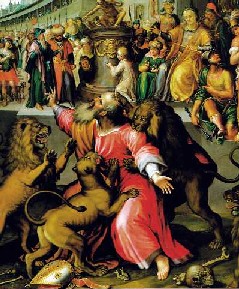
Martyrdom of St. Ignatius of Antioch

While writing only about a decade after Clement, Ignatius' views on a number of issues are clearly diverging from what is found in the New Testament.

One area of difference is communion, or the eucharist.  Ignatius considers the bread to be the flesh of Jesus Christ, rather than just a symbol of Jesus' body.  It seems this position came out of his desire to correct a growing heresy that Jesus had not really risen from the dead with a physical body.  Regarding heretics, he says:
"They abstain from the Eucharist and from prayer, because they confess not the Eucharist to be the flesh of our Saviour Jesus Christ."  Letter to the Smyrnaeans ch. 7

Another first we see in Ignatius' writings is the term "Catholic Church."  Catholic in Greek simply means whole, complete, or universal.  It was a generic term at the time and it seems that Ignatius intended to distinguish the majority of the churches (catholic) from the few that were following clearly heretical teaching.

The most significant change from the New Testament model is found in Ignatius' description of church leadership.  Unlike Clement, Ignatius treats bishops (i.e. overseers) and elders as separate roles in the church, with a lone bishop being in authority over the elders.  He equates the bishop with God the Father, and the elders with the Apostles, and teaches absolute obedience to the bishop as one would give to God.  In terms of church life, the bishop was the only one permitted to authorize baptisms and perform the Eucharist.  In his letter to Polycarp, he even says that people who marry should do so with the approval of the bishop.  Note that in the quotes below that "presbytery" is synonymous with "elders."
"I salute your most worthy bishop, and your very venerable presbytery, and your deacons, my fellow-servants, and all of you individually."  Letter to the Smyrnaeans, ch. 12.
"See that ye all follow the bishop, even as Jesus Christ does the Father, and the presbytery as ye would the apostles; and reverence the deacons, as being the institution of God.  Let no man do anything connected with the Church without the Bishop.  Let that be deemed a proper Eucharist, which is [administered] either by the bishop, or by one to whom he has entrusted it.  Wherever the bishop shall appear, there let the multitude [of the people] also be; even as, wherever Jesus Christ is, there is the Catholic Church.  It is not lawful without the bishop either to baptize or to celebrate a love-feast; but whatsoever he shall approve of, that is also pleasing to God, so that everything that is done may be secure and valid."  Letter to the Smyrnaeans, ch. 8.
"... your bishop presides in the place of God, and your presbyters in the place of the assembly of the apostles, along with your deacons."  Letter to the Magnesians, ch. 6.
"It is well to reverence both God and the bishop.  He who honours the bishop has been honoured by God; he who does anything without the knowledge of the bishop, does serve the devil."  Letter to the Smyrnaeans, ch. 9.

It is not entirely clear how this new office of bishop was instituted, but it clearly was not just an anomaly in Antioch.   In his letter to the Ephesians, he states that bishops "settled everywhere to the utmost bounds" of the earth.  He also specifically mentions the bishop of Smyrna (Polycarp) and the bishop of Ephesus (Onesimus).  Clearly this practice of having a single bishop over the elders of a church had become widespread in a very short period of time after Clement.

Despite his pleas to the churches to obey their bishop, Ignatius is not simply power hungry.  He comes across as a gracious, Godly man in his tone and words.
"I do not issue orders to you, as if I were some great person.  For though I am bound for the name [of Christ], I am not yet perfect in Jesus Christ."  Letter to the Ephesians, ch. 3.

Ignatius' writings show how the early church was quickly adopting a new organizational structure to deal with the heresies that were creeping into the churches.  It seems to have been an intentional change, borne out of good motives to solve a very real and serious problem. However, the consequences would turn out to be severely detrimental in the years that followed.

Error in The Pilgrim Church Book

Broadbent attributes a misuse of Acts 20:17 to Ignatius.
"Commenting on Acts 20, he says that Paul sent from Miletus to Ephesus and called the bishops and presbyters, thus making two titles out of one description, and says that they were from Ephesus and neighboring cities, thus obscuring the fact that one church, Ephesus, had several overseers or bishops." p. 32

After reviewing all of Ignatius' writings, I could find no such reference to Acts 20.  I tracked down Broadbent's source, a book by Henry Alford entitled The Greek Testament Critical Exegetical Commentary.  In Vol. 2, p. 227, Alford does describe this exact misuse of Acts 20, but attributes it to Irenaeus rather than Ignatius.  Problem solved!