Showing posts with label church fathers. Show all posts

Wednesday, 24 October 2012

Cyprian

Like Tertullian, Cyprian (~200 - 258 AD) lived in Carthage (modern Tunis) in North Africa.  He was not baptized as a Christian until the mid-240's AD, but was rapidly put into church leadership roles including bishop in 249 AD.  He was fairly wealthy from a career in the legal profession, and gave some of his wealth to the poor after his baptism.  He was martyred in 258 AD.

His writings deal with controversies in the church during his time in leadership.  He also wrote about the plague that ravaged Carthage during Emperor Valerian's reign, encouraging the Christian's to stay strong in their faith and to help the sick.

One controversy he was involved in was how to deal with believers who had renounced their faith and worshiped the emperor during times of persecution and then desired to return to the church later.  One camp refused to allow them back in the church, while the opposite camp accepted all of them without question.  Cyprian took a middle ground, one that the bishop of Rome agreed with.

Cyprian was also the first early church father who championed infant baptism.  He felt they should be baptized as early as possible. Under his influence, 66 bishops declared themselves in favour of infant baptism in 253 A.D. and within a generation it had become standard practice in the North African churches.

Cyprian based many of his arguments around the term "Catholic Church" meaning the central, authoritative, and traditional church organization that claimed descent from the Apostle Peter.  In his Treatise "On the Unity of the Church" Cyprian refers to Matthew 16:18 where Jesus tells Peter that "on this rock I will build my church" and concludes that the authority given to Peter rests only with the Catholic Church.  Anyone who disagrees with the church leaders is causing disunity and is not part of the true church.  As Broadbent states in The Pilgrim Church (p.34), Cyprian went as far as claiming, "He who is not in the Church of Christ is not a Christian."

The church had now begun to exclude any and all Christians who disagreed with the most powerful bishops on non-core doctrines.  (By "non-core" I mean any doctrines of faith not expressly addressed in the New Testament.)

This large-scale excommunication of Christian believers created new practical problems in the church that had never existed before.  If an excommunicated group baptized people in the name of Christ, are those converts really Christians?  If those converts later come to the Catholic Church and renounce whatever "heresies" that existed in that group, do they need to be baptized again?  Cyprian argued yes; other bishops argued no, but it was an issue that was not resolved in his lifetime.

For the first time in history, it was no longer enough to be baptized in the name of Christ;  Cyprian now taught that one needed to be baptized in the Catholic Church to be a true Christian.

Tuesday, 23 October 2012

Origen

Origen (c 185 - c 254 AD) was born in Alexandria to Christian parents, who named him Origenes Adamantius.  His father Leonides was martyred in 202 AD, and Eusebius relates a story that young Origen wanted to be martyred with his father but was thwarted by his mother who hid his clothes.
Origen was a gifted teacher of the Scriptures and discovered this gift and passion at a young age.  At age 18 (203 AD), the bishop of Alexandria, Demetrius, appointed him to succeed Clement as the leader of the theological school there.  He performed this role for a dozen years until persecution in 215 AD forced him to flee.
Origen traveled through a number of places in his lifetime, including Rome, but he stayed the longest at Caesarea in Palestine.  There he was invited by the bishops to preach in their churches.
Despite his teaching experience and ability, Origen was still a layman and Demetrius was not happy that a layman from his city was preaching in churches in other cities, despite the approval of the local bishops.  He ordered him back to Alexandria, so Origen obeyed and he took up his position at the school.  However, in 230 AD Origen was on his way to Greece when he visited Caesarea again.  The bishops there ordained him, and this really got Demetrius upset.  When Origen returned, he was removed from his teaching position in the school and excommunicated from the church.
Origen returned to Caesarea and opened a new theological school, continued his writings and teaching, and spent the remainder of his life in Palestine.  During another persecution in 250 AD, he was arrested and tortured and died a few years later as a result.

From Origen's teachings and life events, we see the early church changing in the following ways.

  1. Infant baptism is now commonly practiced.  Origen states in his commentary on Romans that infants were baptized in keeping with apostolic tradition, and his writings do not appear to show he disagreed with that tradition.
  2. Church leadership was becoming formalized and separated from the rest of the people in the church.  The idea of clergy and laity had already become entrenched.  The fact that Origen was a more gifted teacher than many bishops did not matter to Demetrius, who excommunicated him for preaching in other churches and being ordained without his approval.  Laymen could teach in a school of theology, but not in a church!
  3. Bishops had absolute authority over church affairs in their own city.  Demetrius excommunicated Origen not because the Christians in Alexandria found him behaving sinfully or because his theology was heretical, but simply because Demetrius was jealous of his abilities and his influence with other bishops.  
  4. Bishops could determine arbitrarily who was part of Christ's church and who was not.  Again, Origen was not excommunicated for immorality but for simply breaking the rules of church procedure.  This is a novel development, for following church rules was never a requirement for being a Christian in the New Testament.
  5. Despite Demetrius' absolute authority in the church in Alexandria, he appears to have had no authority in Palestine, where those bishops openly ignored his decisions and allowed Origen to open a new school and teach in their churches for the final 20 years of his life.  Therefore, churches in each city still operated somewhat independently, each under their own bishop.

Monday, 8 October 2012

Tertullian

Tertullian (c 160 - c 225 AD) was a prolific Christian writer from Carthage, North Africa.  He was the first to use the term Trinity and explain that doctrine.  He never refers to himself with any title, so he may have simply been an educated layman in the church.

Tertullian was never made a saint in the Catholic Church because he held some controversial views.  However, he wrote against many heresies and covered a wide range of theological doctrines and church life, which help paint a picture of the church in his day.

In regards to church leadership, Tertullian mentions one bishop who has authority over the elders and deacons, similar to what Ignatius taught.  However, where Ignatius required the bishop to be present for baptism, Tertullian states that any believer can baptize with the bishop's permission.

"Of giving it [baptism], the chief priest (who is the bishop) has the right: in the next place, the presbyters and deacons, yet not without the bishop’s authority, on account of the honour of the Church, which being preserved, peace is preserved. Beside these, even laymen have the right; for what is equally received can be equally given."  (Tertullian, On Baptism, chapter XVII)

Tertullian argued that baptism should be permitted for children, but only when they were old enough to know Christ and to request it.


"The Lord does indeed say, 'Forbid them not to come unto me.'  Let them come then, while they are growing up; let them come while they are learning, while they are learning wither to come; let them become Christians when they have become able to know Christ."  
"Let them know how to ask for salvation, that you may seem at least to have given 'to him that asketh.' "  (Tertullian, On Baptism, chapter XVIII)

Broadbent suggests Tertullian is arguing against the baptism of infants, but Tertullian does not mention that per se.  He clearly is arguing for believer's baptism though.  Broadbent also mentions that Tertullian condemned the practice of baptizing the dead, but I could find no reference to that practice in Tertullian's writings on baptism.

Broadbent also quotes Tertullian regarding the freedom of religion.

"It is no part of religion to compel religion, which should be adopted freely, not by force."  (Broadbent, The Pilgrim Church, p. 33 from Tertullian, Apologetic To Scapula, chapter II.)

This freedom would be severely jeopardized in later years as the Catholic Church sought to compel orthodoxy through brute force.

Sunday, 24 April 2011

Irenaeus

Irenaeus (~140 - 203 AD) was Bishop of Lugdunum, now Lyons, France.  He was born in Smyrna, raised in a Christian family, and heard Polycarp's teaching in his younger days. It is unclear if he was martyred or not.

Irenaeus wrote a number of books, but only two complete works survive.  The most important is Against Heresies, a five-book series refuting Gnosticism.  The second is A Demonstration of Apostolic Preaching, which may have been used to instruct new believers.

Gnosticism gets its name from the Greek word gnosis, meaning knowledge.  There were many different schools and variations of it, but they all taught some special kind of knowledge was required for salvation.  They freely borrowed from various religions, including Judaism, Roman and Greek traditions, Zoroastrianism, and eventually Christianity.  Because it included Christian concepts and terminology, increasing numbers of Christians were adopting these gnostic beliefs and Irenaeus argued strongly to show how they were contrary to scripture and the apostles' teaching.

In the process of refuting Gnosticism, Irenaeus helped establish what we now call the New Testament.  Because heretical writings started surfacing falsely claiming to be written by one of the apostles, Irenaeus cited those writings that were authentic.  He referred to both the Old Testament and the apostles' writings as "Scripture."

Irenaeus introduced some new concepts, including apostolic succession and the authority of church tradition.  Because the heretics claimed to know more than the apostles did, Irenaeus not only pointed to the apostles' writings, but also to the fact that some of the apostles appointed the first church elders.  Implied in that is that there was first-hand instruction, which ensured clear inheritance of doctrine.  Since heretics were introducing new ideas, church traditions were seen as another way of ensuring consistent doctrine.
But again, when we refer them to that tradition which originates from the apostles, [and] which is preserved by means of the succession of presbyters in the churches, they object to tradition, saying that they themselves are wiser not merely than the presbyters, but even than the apostles, because they have discovered the unadulterated truth. ... It comes to this, therefore, that these men do now consent neither to Scripture nor to tradition.  Against Heresies, Book III, ch. 2.

By documenting a clear succession of appointments of church leaders, later generations would use that as a justification for the authority of the pope.  Pointing to church tradition was fine for the doctrinal points that the church got right, but as the church accepted unbiblical practices, tradition became a justification for ignoring scripture and elevating the decisions of church leaders above all else.

Saturday, 16 April 2011

Polycarp

Polycarp (69 AD - 155 AD) was Bishop of Smyrna, a student of the Apostle John, and a younger contemporary of Ignatius.  He was martyred at an old age by burning at the stake, but when the flames failed to touch him, he was stabbed to death.

Polycarp was a recipient of one of Ignatius' letters that he wrote on his way to his execution.  Ignatius refers to Polycarp in his letter to the church in Smyrna as "your most worthy bishop."
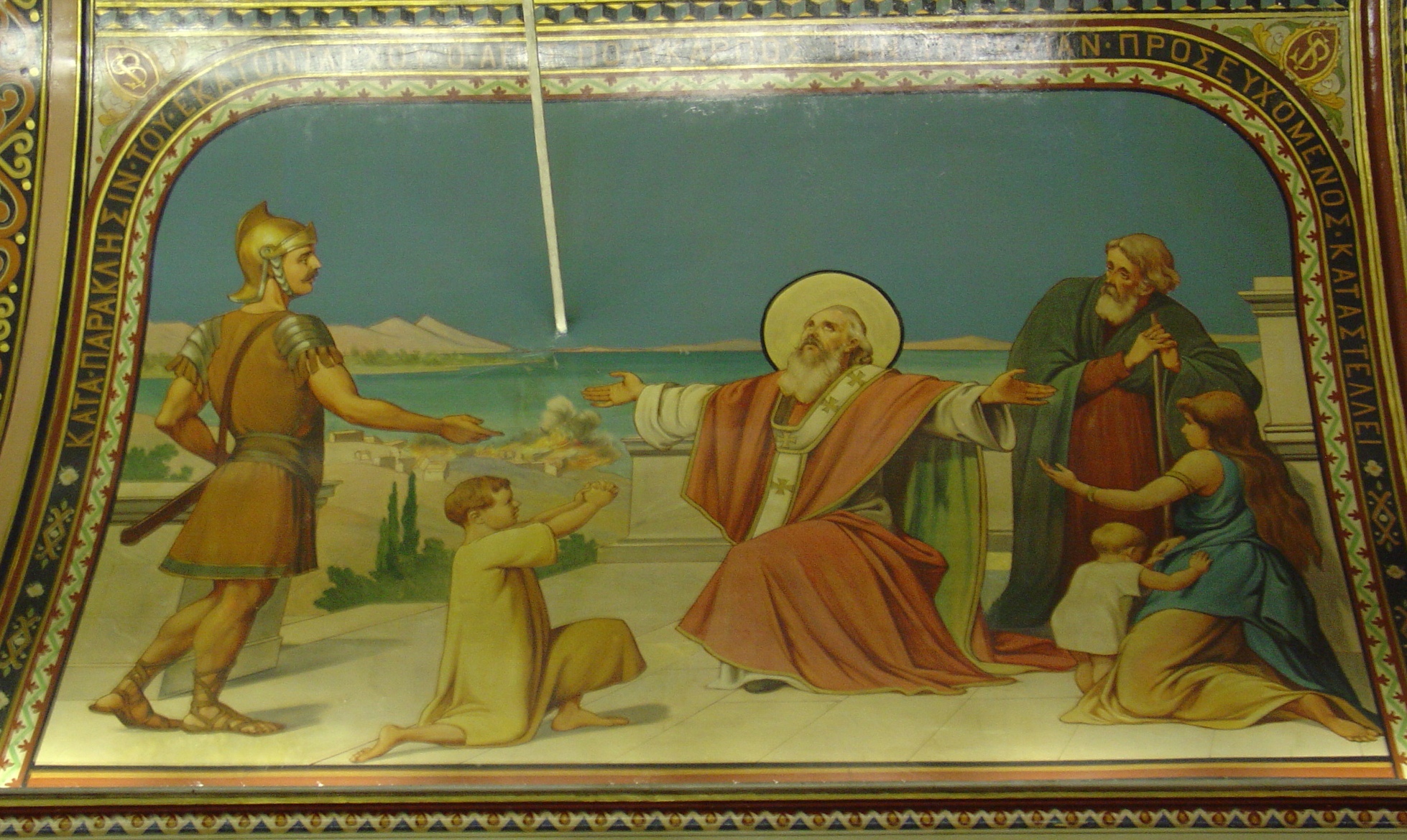
Church icon from St. Polycarp's Roman Catholic Church
 in Izmir, Turkey (ancient Smyrna).  Photo by P. Vasiliadis.

Iranaeus records that Polycarp visited Anicetus, the Bishop of Rome, to discuss areas of difference between that church and the chruches in Asia Minor.  They came to agreement on some issues, but agreed to disagree on the exact dating of Easter.

Only a single document of Polycarp exists, his Letter to the Philippians.  He does not give himself a title, but refers to the elders with him.  He gives character requirements for both deacons and elders.  He refers to Paul and the letter he wrote to the Philippians.  He also mentions Ignatius and his letters, and encourages the Philippians to read them, "for they comprise faith and endurance and every kind of edification, which pertaineth unto our Lord."

According to Iranaeus, Polycarp fought against the false teachings of the Marcionites and converted many followers of that teaching when he visited Rome.  In his letter, Polycarp affirms Jesus' coming in the flesh, his death on the cross, and his resurrection, each of which were denied by various heresies.

It seems Polycarp was not as well-educated as other early church fathers.  However, that did not seem to slow him in his efforts to teach true doctrine.
"For I am persuaded that ye are well trained in the sacred writings, and nothing is hidden from you.  But to myself this is not granted."  Letter to the Philippians, ch. 12.

Polycarp's connection to the Apostle John gave him an authority in his teaching against heresies that helped stabilize the early church and move it forward.

Saturday, 9 April 2011

Ignatius

Ignatius (~35 AD - 107 AD) was Bishop of Antioch in Syria.  He was likely a student of the Apostle John, along with his friend Polycarp who was Bishop of Smyrna.  Ignatius was arrested and escorted by soldiers to Rome to be executed by wild beasts in the arena.  Along the way, he wrote 6 letters to churches and one letter to Polycarp.
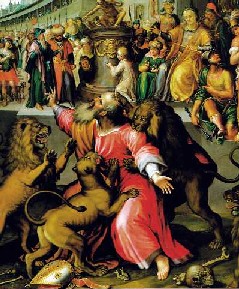
Martyrdom of St. Ignatius of Antioch

While writing only about a decade after Clement, Ignatius' views on a number of issues are clearly diverging from what is found in the New Testament.

One area of difference is communion, or the eucharist.  Ignatius considers the bread to be the flesh of Jesus Christ, rather than just a symbol of Jesus' body.  It seems this position came out of his desire to correct a growing heresy that Jesus had not really risen from the dead with a physical body.  Regarding heretics, he says:
"They abstain from the Eucharist and from prayer, because they confess not the Eucharist to be the flesh of our Saviour Jesus Christ."  Letter to the Smyrnaeans ch. 7

Another first we see in Ignatius' writings is the term "Catholic Church."  Catholic in Greek simply means whole, complete, or universal.  It was a generic term at the time and it seems that Ignatius intended to distinguish the majority of the churches (catholic) from the few that were following clearly heretical teaching.

The most significant change from the New Testament model is found in Ignatius' description of church leadership.  Unlike Clement, Ignatius treats bishops (i.e. overseers) and elders as separate roles in the church, with a lone bishop being in authority over the elders.  He equates the bishop with God the Father, and the elders with the Apostles, and teaches absolute obedience to the bishop as one would give to God.  In terms of church life, the bishop was the only one permitted to authorize baptisms and perform the Eucharist.  In his letter to Polycarp, he even says that people who marry should do so with the approval of the bishop.  Note that in the quotes below that "presbytery" is synonymous with "elders."
"I salute your most worthy bishop, and your very venerable presbytery, and your deacons, my fellow-servants, and all of you individually."  Letter to the Smyrnaeans, ch. 12.
"See that ye all follow the bishop, even as Jesus Christ does the Father, and the presbytery as ye would the apostles; and reverence the deacons, as being the institution of God.  Let no man do anything connected with the Church without the Bishop.  Let that be deemed a proper Eucharist, which is [administered] either by the bishop, or by one to whom he has entrusted it.  Wherever the bishop shall appear, there let the multitude [of the people] also be; even as, wherever Jesus Christ is, there is the Catholic Church.  It is not lawful without the bishop either to baptize or to celebrate a love-feast; but whatsoever he shall approve of, that is also pleasing to God, so that everything that is done may be secure and valid."  Letter to the Smyrnaeans, ch. 8.
"... your bishop presides in the place of God, and your presbyters in the place of the assembly of the apostles, along with your deacons."  Letter to the Magnesians, ch. 6.
"It is well to reverence both God and the bishop.  He who honours the bishop has been honoured by God; he who does anything without the knowledge of the bishop, does serve the devil."  Letter to the Smyrnaeans, ch. 9.

It is not entirely clear how this new office of bishop was instituted, but it clearly was not just an anomaly in Antioch.   In his letter to the Ephesians, he states that bishops "settled everywhere to the utmost bounds" of the earth.  He also specifically mentions the bishop of Smyrna (Polycarp) and the bishop of Ephesus (Onesimus).  Clearly this practice of having a single bishop over the elders of a church had become widespread in a very short period of time after Clement.

Despite his pleas to the churches to obey their bishop, Ignatius is not simply power hungry.  He comes across as a gracious, Godly man in his tone and words.
"I do not issue orders to you, as if I were some great person.  For though I am bound for the name [of Christ], I am not yet perfect in Jesus Christ."  Letter to the Ephesians, ch. 3.

Ignatius' writings show how the early church was quickly adopting a new organizational structure to deal with the heresies that were creeping into the churches.  It seems to have been an intentional change, borne out of good motives to solve a very real and serious problem. However, the consequences would turn out to be severely detrimental in the years that followed.

Error in The Pilgrim Church Book

Broadbent attributes a misuse of Acts 20:17 to Ignatius.
"Commenting on Acts 20, he says that Paul sent from Miletus to Ephesus and called the bishops and presbyters, thus making two titles out of one description, and says that they were from Ephesus and neighboring cities, thus obscuring the fact that one church, Ephesus, had several overseers or bishops." p. 32

After reviewing all of Ignatius' writings, I could find no such reference to Acts 20.  I tracked down Broadbent's source, a book by Henry Alford entitled The Greek Testament Critical Exegetical Commentary.  In Vol. 2, p. 227, Alford does describe this exact misuse of Acts 20, but attributes it to Irenaeus rather than Ignatius.  Problem solved!


Tuesday, 5 April 2011

Clement

Clement (~30 AD - ~100 AD) is also known as Saint Clement of Rome or Pope Clement I, although there was certainly no office of Pope in his lifetime.  He was a bishop (i.e. overseer) in the church at Rome, and Roman Catholic tradition says he was appointed by the Apostle Peter himself and is the same Clement that is mentioned in Philippians 4:3.  (I find the latter point doubtful, but no one knows for sure.)  He was banished by the Emperor Trajan to Crimea in the Ukraine to work in a stone quarry and was most likely martyred there.

He is known mainly for his letter to the church in Corinth, known as 1 Clement or the Epistle of Clement.  It was written in the mid-90's AD and is probably the oldest document from the early church that was not included in the New Testament.  In it, he apologizes for being tardy in addressing a dispute in the Corinthian church due to "sudden and repeated calamities and reverses which are befalling us," presumably referring to persecution that occurred under the Emperor Domitian.  He also refers to the deaths of the Apostles Peter and Paul, and mentions that Paul "reached the farthest bounds in the West" (1 Clem 5:6), apparently confirming that Paul completed his planned journey to Spain (Rom. 15:24, 28).

The issue in the Corinthian church was the removal of some elders, and Clement rebukes the people in the church who did this.  Apparently it was not due to any sin on the part of the leaders, but "for the sake of one or two persons." (1 Clem. 47:6)

Clement uses the terms "elders" and "overseers" interchangeably, just as they are used in the New Testament, and he refers to the leaders of the Corinthian church in the plural.  He also mentions "deacons" as serving the overseers/elders.  There is no sense that Clement considered himself to have any authority over the Corinthian church and he gives himself no title in the epistle.  Despite the Roman Catholic church assigning him the title "Bishop of Rome" centuries later, there is no evidence anyone called him that during his lifetime.  He writes as a brother who is on an equal footing with a fellow church.
"These things, dearly beloved, we write, not only as admonishing you, but also as putting ourselves in remembrance. For we are in the same lists, and the same contest awaiteth us."  1 Clem 7:1

There is a passage in this epistle used by the Roman Catholic church to affirm the succession of the popes beginning with Peter.  Clement says:
"And our Apostles knew through our Lord Jesus Christ that there would be strife over the name of the bishop's office.  For this cause therefore, having received complete foreknowledge, they appointed the aforesaid persons, and afterwards they provided a continuance, that if these should fall asleep, other approved men should succeed to their ministration. Those therefore who were appointed by them, or afterward by other men of repute with the consent of the whole Church, and have ministered unblamably to the flock of Christ in lowliness of mind, peacefully and with all modesty, and for long time have borne a good report with all these men we consider to be unjustly thrust out from their ministration."  1 Clem 44:1-2

From the context of the epistle, it is clear that Clement is simply saying that the overseers who were appointed by the original Apostles were expected to be replaced when they died.  It's also interesting to see leaders were appointed "with the consent of the whole Church" and not by a single leader in authority over that church.

From my reading of the epistle, Clement's main arguments why the Corinthian church should not have deposed its overseers are:
  1. They were appointed by the Apostles and the church should not overrule the decisions of the Apostles, as they were appointed by Jesus Christ personally.  I already quoted 1 Clem. 44:2 above, and 1 Clem. 42:4 says in regards to the Apostles:
    "So preaching everywhere in country and town, they appointed their firstfruits, when they had proved them by the Spirit, to be bishops and deacons unto them that should believe.

  2. The authority structure in the church is rooted in the Old Testament, and should not be challenged.  Clement quotes Isaiah 60:17 when he says:
    "And this they did in no new fashion; for indeed it had been written concerning bishops and deacons from very ancient times; for thus saith the scripture in a certain place, I will appoint their bishops in righteousness and their deacons in faith."  1 Clem. 42:5
    Note that Isaiah 60:17 (NIV) actually says, "I will make peace your governor and righteousness your ruler."  Clement also refers to God's choice of Aaron as priest (1 Clem 43), implying the absolute and life-long nature of the office. 
The key point that Clement's epistle demonstrates is that immediately after the New Testament is closed, the churches appear to be operating using the model of leadership outlined in the New Testament itself, namely plurality of elders/overseers and each church operating under its own autonomy but in relationship to neighbouring churches and leaders.  However, as Broadbent notes: "Yet even here the beginning of a distinction between clergy and laity is already evident, drawn from Old Testament ordinances." (The Pilgrim Church, p. 31)  The change in perspective is subtle, but these seeds of basing the authority of church leaders on Old Testament models and of the establishment of an hierarchical model of church authority would produce a lot of problems in the years that followed.